
To compare contractor bids fairly, compare the scope first and the price last. Line up what each bid includes, what it leaves out, its allowances, its timeline, its payment schedule and its warranty. Only when those match does the bottom-line number tell you which bid is actually cheaper.
Three bids for the same kitchen can be thousands of dollars apart and all be honest. One contractor priced the cabinets you picked; another priced a basic allowance; a third left out the drywall repair behind the old backsplash. This checklist turns a stack of quotes in three different formats into a side-by-side comparison you can decide on.
Before you compare: give every contractor the same scope
Most bid confusion starts before the bids arrive. If you describe the job one way on the phone and another way on site, each contractor fills the gaps with their own assumptions, and you end up comparing three different projects.
Write the job down item by item: "remove old cabinets and countertops", "install new base and wall cabinets", "new countertops", "tile backsplash", "patch and paint walls", "haul away debris". Send the same list, the same photos and the same measurements to everyone. Say what finish level you want and who is buying materials. Then ask each contractor for an itemized bid that separates materials from labor, so you can see where the money goes.
Step 1: Check that every bid covers the whole scope
Make a simple table. Put your scope items down the left side and one column for each contractor. For every line, mark it included, excluded or unclear. A single-line bid like "Kitchen remodel: $28,000" can't be checked this way, so ask that contractor to break it out before you go further.
The lines that most often go missing are the unglamorous ones: demolition and haul-away, dumpster or disposal fees, permits and inspection fees, drywall repair and paint after the work, electrical or plumbing changes, and final cleanup. A bid that skips two of those can look like the low price and end up the most expensive.
Step 2: Read the exclusions and assumptions
Look for lines that start with "excludes", "by owner" or "assumes". "Assumes existing subfloor is sound" is reasonable, since nobody can see under your floor before demolition, but you should know what happens if it isn't. Ask each contractor how they price a surprise: a written change order with a price before the extra work starts is what you want. "We'll figure it out" is not.
Step 3: Compare allowances, not just totals
An allowance is a placeholder amount for something you haven't chosen yet, such as tile, light fixtures or a faucet. If you pick something that costs more than the allowance, you pay the difference. That makes allowances the easiest way for a bid to look cheaper than it is: a bid with a low tile allowance isn't cheaper, it has just moved part of the cost to later.
For each allowance, ask what it buys and whether it covers the material only or the installation too. To compare fairly, adjust every bid to the same allowance amounts, or pick your finishes before you sign so allowances shrink to a few small items.
Step 4: Line up the timeline
Compare the start date, the expected duration, and who handles permits and inspections. A contractor who can start next week may be the right choice, or may simply be the one with no other work. Ask what usually causes delays on a job like yours and how they'll keep you informed. Put the start date and duration in the contract, not only in the bid.
Step 5: Look hard at the payment schedule
Compare how much each contractor wants up front and what triggers every later payment. The safest schedules tie payments to finished, visible work ("cabinets installed", "countertops set") rather than to calendar dates, and hold back the final payment until the punch list is done and the job has passed any required inspection.
Some states limit how large a deposit a home improvement contractor can take, so check with your state's contractor licensing board. Be wary of a contractor who wants most of the money before work starts, or wants cash only. Whatever you pay, get a receipt that names the project and what the payment was for.
Step 6: Compare warranties
A workmanship warranty covers the contractor's labor; product warranties come from the manufacturer and are separate. Compare how long each workmanship warranty lasts, what it covers and what it excludes, and make sure it's written into the contract. A one-year warranty in writing is worth more than a "lifetime" promise made in conversation.
Step 7: Check the contractor, not just the bid
Before you choose, verify the license with your state's contractor licensing board if your state licenses the trade, and ask for a certificate of insurance showing general liability coverage, plus workers' compensation if they have employees. Ask who will pull the permit. If a contractor asks you to pull it yourself as the owner, you may be taking on responsibility for the work passing inspection.
If your home was built before 1978, there's one more check. EPA's Renovation, Repair and Painting Rule requires anyone paid to do work that disturbs painted surfaces in pre-1978 homes to be certified in lead-safe work practices, and EPA says about three-quarters of U.S. homes built before 1978 still contain some lead-based paint. You can confirm a firm's certification with EPA's lead-safe certified firm search.
Red flags when comparing bids
One bid is far below the others with no explanation. Ask what it leaves out before you get excited about the savings.
The bid is a single line, or the contractor won't put the scope in writing.
There's pressure to sign today, a "special price" that expires tonight, or a request for a large cash payment up front.
The contractor won't put changes in writing, or says permits aren't needed for work that clearly changes plumbing, wiring or structure.
Should you just pick the lowest bid?
Not automatically. Pick the lowest complete bid: the one that covers your full scope with realistic allowances and a payment schedule you're comfortable with. If a higher bid still looks better, ask that contractor what the difference buys. Sometimes it's better materials, a longer warranty or a crew that can start sooner, and sometimes you can trim scope together rather than haggle over the total.
Once you've chosen, the bid becomes the basis of your contract. Make sure the contract repeats the scope, allowances, schedule, payment plan and warranty you compared, so nothing you relied on gets lost between the quote and the signature.
An easier way to line bids up
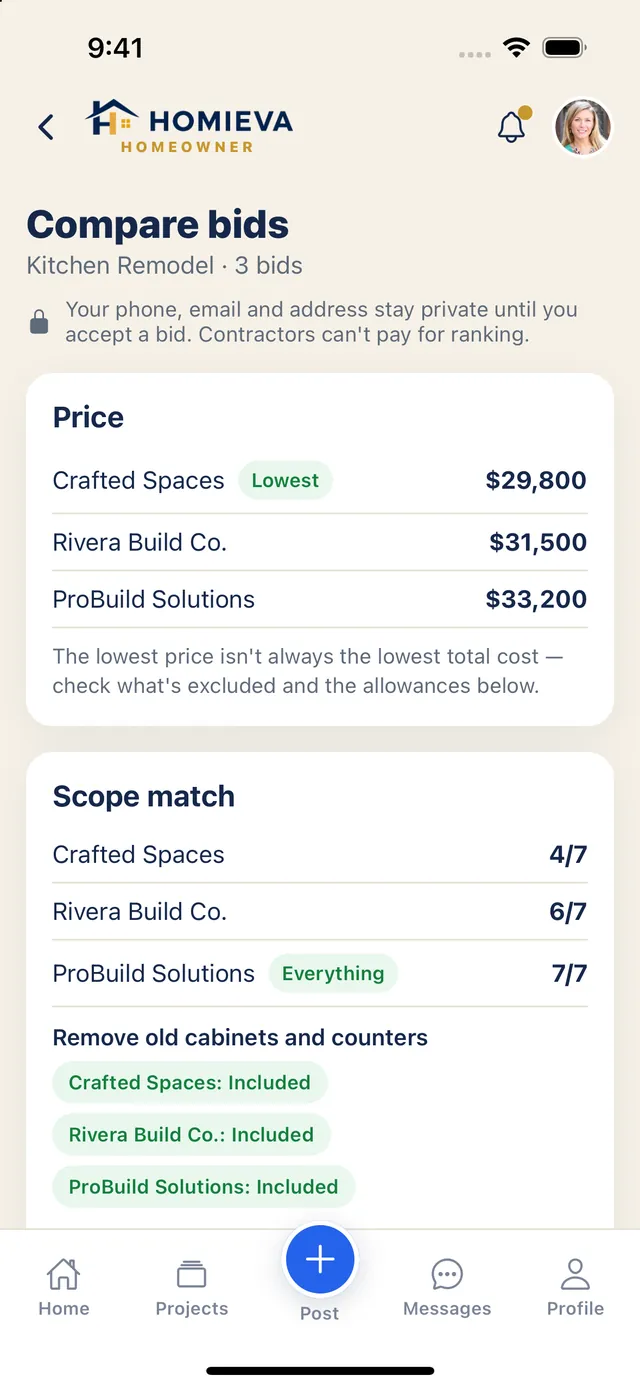
Homieva does the table for you. When you post a project, you list the job item by item, and every bid that comes back marks each line as included, excluded or needing clarification. The comparison shows price, scope match, timeline, payment plan and warranty side by side, flags bids that leave part of your scope out, and keeps your phone number and address private until you accept one. You can see how it works for homeowners or try comparing sample bids in the live demo.