
Before you hire a contractor, ask about five things: their license and insurance, who pulls the permits, the schedule and who will be on site, how payments and changes work, and what the warranty covers. Ask the same questions of every contractor you're considering, write the answers down, and get anything that matters into the written contract.
The questions below are grouped in the order you'll usually need them, from the first phone call to the day before you sign. You don't have to ask all twenty in one sitting. The point is that by the time you sign, every one of them has a clear answer, preferably in writing.
Questions about license and insurance
1. "What is your contractor license number, and what type of work does it cover?" Many states license contractors, and some license specific trades such as electrical, plumbing or roofing. Look the number up yourself on your state's contractor licensing board website rather than relying on a photo of a card. California's Contractors State License Board (CSLB), for example, tells homeowners that seeing a license number doesn't necessarily mean the license is valid, and to check its status and disciplinary history online.
2. "Is the person I'm talking to the license holder, or a salesperson?" Some states register home improvement salespeople separately. Ask for a photo ID and make sure the names match the license or registration.
3. "Can you send me a certificate of insurance?" Ask for general liability coverage, which protects your property if something is damaged, and workers' compensation if they have employees. The CSLB explains that in California a contractor with employees must carry workers' compensation, and that if an uninsured worker is hurt on your property you could be financially liable. Rules differ by state, so check yours, and call the insurer on the certificate if anything looks off.
4. "Is your business address and phone number current?" You want to be able to find this contractor after the last bill is paid, when something needs fixing under warranty.
Questions about experience and references
5. "How many jobs like mine have you done recently?" A great deck builder may not be the right choice for a bathroom with new plumbing. Ask about work that matches your scope, size and house age.
6. "Can I talk to two or three recent customers?" When you call them, ask whether the job finished on time and on budget, how surprises were handled and whether they'd hire the contractor again. Ask the contractor for photos of finished work too.
7. "Do you use subcontractors, and for which parts of the job?" It's normal for a general contractor to use subs for electrical, plumbing or HVAC. You want to know who they are, whether they're licensed for their trade and who supervises them.
Questions about permits and the house
8. "Does this job need a permit, and who will pull it?" The contractor should know your local requirements and should pull the permit themselves. If you pull it as the owner, you may be taking on responsibility for the work passing inspection.
9. "Which inspections will there be, and will you be here for them?" Payments tied to passed inspections are a simple way to make sure the work is checked before you pay for it.
10. "My home was built before 1978. Is your firm lead-safe certified?" EPA's Renovation, Repair and Painting Rule requires firms paid to do work that disturbs painted surfaces in pre-1978 homes to be certified and to follow lead-safe work practices. You can check a firm on EPA's lead-safe certified firm search.
Questions about the schedule and the crew
11. "When can you start, and how long will the job take?" Get both in the contract. Ask what's most likely to push the date back on a job like yours, such as material lead times, inspections or weather.
12. "Who will be on site day to day, and who is my main contact?" Ask how you'll get updates and how quickly they usually reply to messages.
13. "What hours will the crew work, and how will you protect the rest of the house?" Dust barriers, floor protection, where materials are stored, which bathroom the crew can use and daily cleanup are all easier to agree on before work starts than in the middle of it.
Questions about the price and payments
14. "Can you give me an itemized written bid?" A single-line bid can't be compared with anyone else's. Ask for scope, materials and labor broken out, with exclusions spelled out. The CSLB suggests getting at least three written bids on identical plans and scope, and warns that a bid far lower than the rest often means a mistake or missing work. Our guide on how to compare contractor bids walks through lining them up.
15. "Which items are allowances, and what do they cover?" An allowance is a placeholder amount for something you haven't chosen yet, like tile or light fixtures. If what you pick costs more, you pay the difference, so ask what each allowance buys and whether it includes installation.
16. "What is the payment schedule, and what triggers each payment?" The safest schedules tie payments to finished, visible work rather than to calendar dates, and hold back the final payment until the punch list is done. Some states cap deposits. In California, for example, the CSLB says a home improvement down payment should never exceed 10 percent of the contract price or $1,000, whichever is less, with an exception for certain bonded contractors. Check your own state's licensing board for the rule where you live.
17. "How do you handle changes and surprises?" The answer you want is a written change order, with the price and any schedule change, signed before the extra work starts. The CSLB notes that a signed change order becomes part of the written contract. "We'll sort it out at the end" is the answer that leads to disputes.
Questions about the contract and the finish
18. "Will everything we've discussed be in the written contract?" A good contract describes the work, the materials (brand, model and color where it matters), the price, when payments are due, who gets the permits and when the job will be finished. California, for example, requires a written contract for home improvement projects over $500 in combined labor and materials. If a promise was made out loud, ask for it in writing.
19. "What does your warranty cover, and for how long?" A workmanship warranty covers the contractor's labor; product warranties come from the manufacturer. Ask how long it lasts, what it excludes and how you'd make a claim, and make sure it's written into the contract.
20. "How do we finish the job?" Ask how the final walkthrough and punch list work and how cleanup and debris removal are handled. Ask for the paperwork you'll want later: permits, inspection sign-offs, warranties and product manuals.
Answers that should make you pause
Some answers are worth stopping on. A contractor who can't give a license number that checks out in a state that licenses the trade, won't provide proof of insurance, or asks you to pull the permit yourself is shifting risk onto you.
So is pressure to sign today, a "special price" that expires tonight, a request for a large cash payment before any work starts, or a refusal to put the scope or changes in writing. The CSLB's advice is never to sign a blank or partly blank contract, and not to sign until you understand and agree to every term; you may also wish to have an attorney review it.
Keep the answers in one place
Write each contractor's answers down next to their bid, so you're comparing like with like. Once you choose, the answers to questions 11 through 20 belong in the contract. Keep the contract, change orders, receipts and warranties together afterwards; you'll want them if there's a warranty claim or when you sell the house.
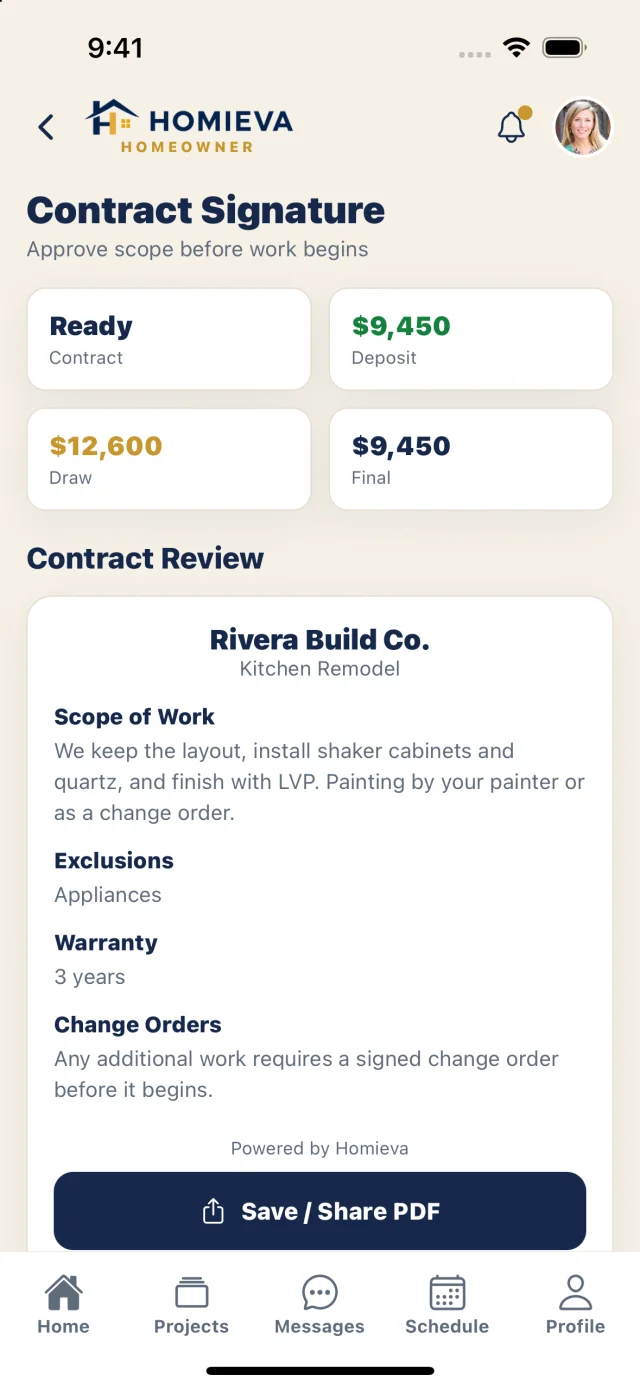
Homieva is built around that record. Contractors bid on your project in the same structured format and ask their questions in a Q&A thread inside Homieva, so you can compare scope, timeline, payment plan and warranty side by side. Once you accept a bid, the contract and every change order are signed on the same Project ID, and each change is approved before the work starts. You can see how it works for homeowners or open the live demo with sample data.